
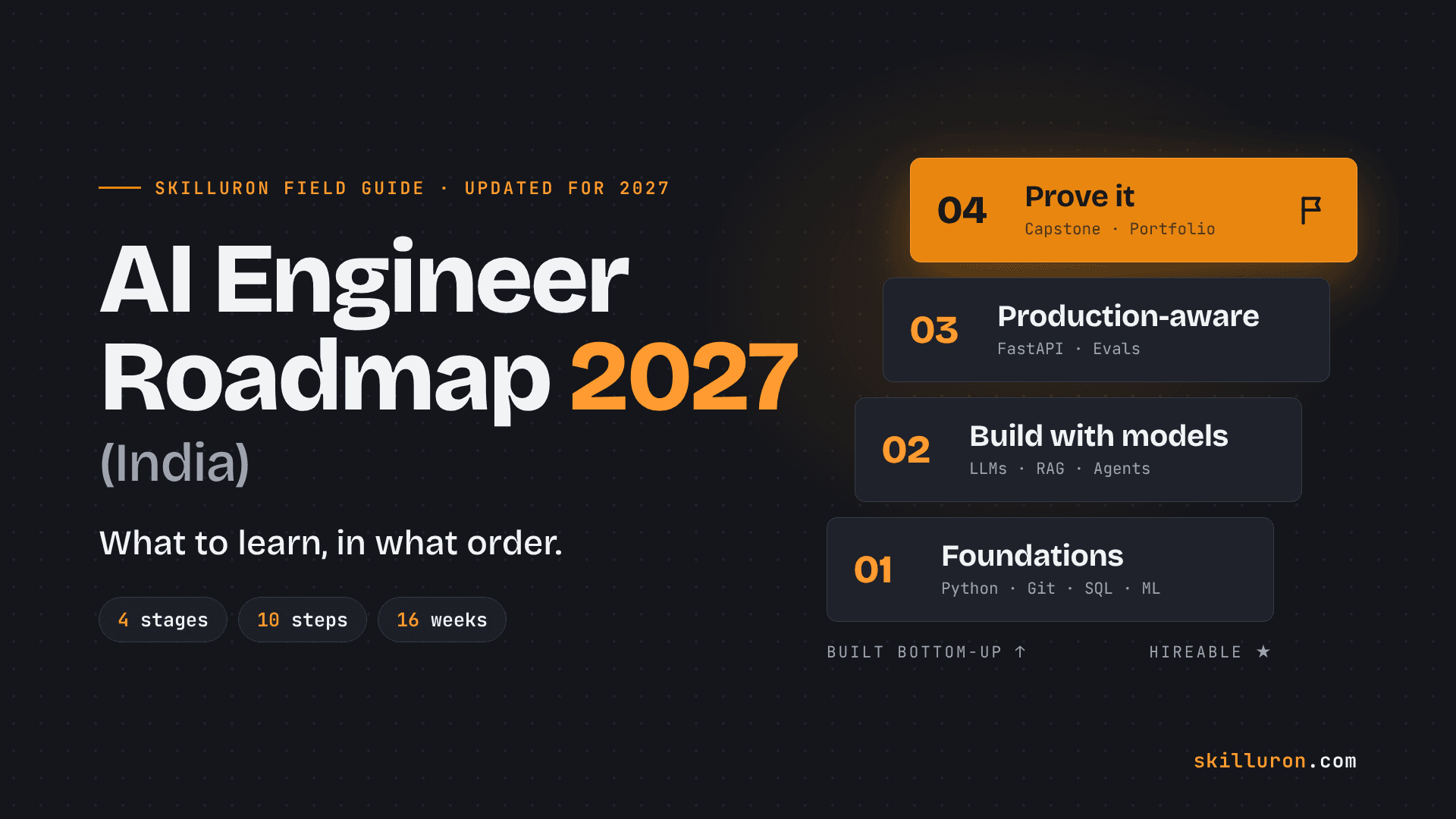
Most roadmaps hand you a list of 40 tools. This one gives you 10 steps in the order hiring teams actually test them, a project that proves each one, and a self-check you can run in Python to find out exactly where to start.
The short version
- An AI engineer builds reliable products on top of models like GPT, Claude, Gemini and open models. You don't need to train models from scratch to get hired.
- Learn in this order: Python and engineering basics → LLM APIs → RAG → agents → backend → evaluations → capstone. Skipping ahead to agents is the most common way people stall.
- Expect about 16 weeks at 12–15 hours a week if you already write basic Python. Add 8–10 weeks if you don't.
- Indian job descriptions keep asking for the same handful of things: Python, RAG, LangChain/LangGraph, FastAPI, vector databases, evaluation and guardrails, and more and more often MCP.
- Certificates support your profile. A public project with tests, an evaluation report and a live demo is what gets you shortlisted.
What an AI engineer actually does
The title gets used loosely, so let's be precise. An AI engineer is a software engineer who builds products on top of foundation models. That means calling model APIs, retrieving the right data, letting models use tools, wrapping it all in a backend, and proving it works.
A ChatGPT clone isn't the job. Think of an assistant that answers questions from a bank's 400-page policy manual, cites the exact page, refuses when it doesn't know, and costs under ₹1 per query.
One industry roadmap puts it well: the 2026 generative AI job is reliability engineering around models, not model building. In practice that means less PyTorch and more evaluations, retry logic and failure handling.
AI Engineer vs ML Engineer vs Data Scientist
AI Engineer
- Core question: How do we ship a reliable product with this model?
- Daily work: RAG pipelines, agents, APIs, evals, guardrails
- Maths needed: working intuition
- Closest cousin: backend engineer
ML Engineer
- Core question: How do we train and serve a better model?
- Daily work: training, tuning, MLOps, model serving
- Maths needed: strong
- Closest cousin: research or infrastructure engineer
Data Scientist
- Core question: What does the data tell us to do?
- Daily work: analysis, experiments, dashboards, statistics
- Maths needed: strong in statistics
- Closest cousin: analyst
Why India, why now
The numbers from 2026 are hard to ignore. Read the last one twice, though. It matters more than the first three.
- 59.5%: year-on-year growth in AI engineering job postings in India, ahead of the US, UK, France and Germany. (LinkedIn AI Labour Market Update, Apr 2026)
- #1: "AI Engineer" was the fastest-growing job in both Bengaluru and Hyderabad. (LinkedIn Jobs on the Rise 2026)
- 260%: growth in demand for agentic AI engineers in 2026 compared with 2025, the sharpest rise among emerging tech roles tracked. (CIEL HR via Business Today)
- 23%: share of India's early-career tech talent rated "AI-native". About 70% are AI-proficient, and the biggest gaps are orchestration and technical depth. (Nasscom AI-Native Talent Index, Jul 2026)
Put those together and you get the real picture. Demand is rising fast for people who can engineer with AI. Meanwhile, almost everyone already uses AI. Nasscom found that more than 90% of early-career tech professionals use AI tools, and warned that India risks building a workforce that is AI-reliant rather than AI-native.
That gap is what this roadmap is designed to close.
Find your stage: run this self-check
Don't start at step one just because it's step one. Copy the script below into any Python environment (Google Colab works). Change each False to True only for what you could do today, without a tutorial open, then run it.
# AI Engineer Roadmap self-check (Skilluron)
# Set each answer to True or False, then run.

answers = {
    1: {  # Stage 1: Foundations
        "Python script with functions, classes, error handling, in its own venv": False,
        "Pushed code to GitHub using branches and clear commits": False,
        "Called a REST API, parsed JSON, wrote a SQL JOIN": False,
        "Can explain overfitting, train/test split, precision vs recall": False,
    },
    2: {  # Stage 2: Build with models
        "Got validated, structured JSON back from an LLM API": False,
        "Built a Q&A app over my own documents with embeddings": False,
        "Built an agent that calls a real tool and handles failures": False,
    },
    3: {  # Stage 3: Production-aware
        "Put an AI feature behind FastAPI and ran it in Docker": False,
        "Built a test set to measure my LLM app and compared two versions": False,
    },
    4: {  # Stage 4: Prove it
        "Public AI project with README, architecture notes and a runnable demo": False,
    },
}

names = {1: "Foundations", 2: "Build with models", 3: "Production-aware", 4: "Prove it"}
score = sum(v for stage in answers.values() for v in stage.values())

for stage, checks in answers.items():
    missing = [skill for skill, done in checks.items() if not done]
    if missing:
        print(f"Score: {score}/10")
        print(f"Start at Stage {stage}: {names[stage]}")
        print("Work on first:")
        for skill in missing:
            print(f"  - {skill}")
        break
else:
    print("Score: 10/10. You're interview-ready. Go straight to Step 10.")
What the result means: your starting stage is the first group with anything still marked False. The script also lists exactly which skills to work on first.
The roadmap: 4 stages, 10 steps
Each step tells you what to learn, what to skip, and the proof project that shows you've actually learned it. Time estimates assume 12–15 hours a week.
- Stage 1 · Foundations (Weeks 1–6): Steps 01–03
- Stage 2 · Build with models (Weeks 7–11): Steps 04–06
- Stage 3 · Make it production-aware (Weeks 12–14): Steps 07–08
- Stage 4 · Prove it (Weeks 15–16+): Steps 09–10
Stage 1: Foundations (Weeks 1–6)
Write code other engineers trust. Everything later is built on this.
Step 01: Python like an engineer, not a student
Learn
- Functions, classes, dataclasses, type hints
- Virtual environments and packaging (venv, pip or uv)
- Error handling and logging
- Testing with pytest
- async/await basics (LLM calls are slow, so this matters)
Free resources: Official Python tutorial, MIT's Missing Semester (shell, Git, debugging)
# Engineer-style Python: typed, testable, handles failure
import requests

def get_json(url: str, timeout: float = 5.0) -> dict:
    try:
        resp = requests.get(url, timeout=timeout)
        resp.raise_for_status()
        return resp.json()
    except requests.RequestException as err:
        raise RuntimeError(f"Request failed: {err}") from err
Your turn: write a pytest test that checks get_json raises RuntimeError when given a URL that doesn't exist.
Step 02: Git, APIs, SQL and data handling
Learn
- Git branches, pull requests, readable commits
- HTTP, REST, JSON, status codes, auth headers
- SQL: SELECT, JOIN, GROUP BY, indexes
- Pandas for cleaning messy files
Free resources: GitHub Skills, SQLBolt
Your turn: look at your last GitHub repo. Could a stranger understand what changed and why from your commit messages alone? If not, that's your first fix.
Step 03: Machine learning, just enough
Learn
- Supervised vs unsupervised learning
- Train, validation and test splits; overfitting
- Metrics: accuracy, precision, recall, F1
- Embeddings: text as vectors, similarity as distance
- What a neural network does, at a conceptual level
Free resources: fast.ai Practical Deep Learning, scikit-learn user guide
Quick check: a spam filter flags 100 emails as spam and 90 really are spam. Is that precision or recall? (Answer: precision, 90%. Recall would ask how many of all the real spam emails it caught.)
Stage 2: Build with models (Weeks 7–11)
The core of AI engineering: get models to do useful, grounded work.
Step 04: LLM fundamentals and APIs
Learn
- Tokens, context windows, temperature
- Prompt design: roles, examples, constraints
- Structured outputs with JSON schema and Pydantic
- Streaming responses
- Cost and latency per call; comparing GPT, Claude, Gemini and open models
Free resources: Andrej Karpathy: Neural Networks, Zero to Hero, and each provider's official API quickstart
# Structured output: the model must fill this shape, or you reject it
from pydantic import BaseModel, ValidationError

class Invoice(BaseModel):
    vendor: str
    invoice_number: str
    total_inr: float

def parse_invoice(llm_json: str) -> Invoice | None:
    try:
        return Invoice.model_validate_json(llm_json)
    except ValidationError:
        return None  # log it, retry, or send for human review

print(parse_invoice('{"vendor": "Acme", "invoice_number": "INV-7", "total_inr": 4999}'))
print(parse_invoice('{"vendor": "Acme", "total_inr": "not a number"}'))  # -> None
Your turn: run the snippet, then add a gstin: str field and see which of the two test inputs now fails.
Step 05: Retrieval-augmented generation (RAG)
Learn
- Document loading and chunking strategies
- Embeddings and vector stores (pgvector, FAISS)
- Hybrid search (keyword + vector) and reranking
- Citations, and answering "I don't know" when retrieval fails
How RAG works, in one line: documents → chunks → embeddings → vector store → retrieve and rerank → LLM answers only from those chunks, with citations.
Free resources: Hugging Face Learn (LLM course), LangChain retrieval docs
Your turn: ask your RAG app three questions the document definitely doesn't answer. If it answers any of them confidently, you've found your first bug.
Step 06: Agents, tool use and MCP
Learn
- Function and tool calling
- State machines and routing with LangGraph
- Retries, timeouts and human-in-the-loop approval
- Model Context Protocol (MCP): the open standard for connecting models to tools
How an agent loop works: plan → call a tool → check the result → retry, or ask a human for approval → respond.
Free resources: modelcontextprotocol.io, LangGraph docs, Hugging Face Agents course
Stage 3: Make it production-aware (Weeks 12–14)
The step most self-learners skip, and the one interviewers dig into.
Step 07: Backend engineering with FastAPI
Learn
- FastAPI routes, Pydantic models, async endpoints
- PostgreSQL and Redis caching
- Authentication basics and rate limiting
- Docker, environment variables, deploying to a cloud
Free resources: FastAPI official tutorial, Docker's "Get started" guide
# Your RAG app, served as an API
from fastapi import FastAPI
from pydantic import BaseModel

app = FastAPI()

class Question(BaseModel):
    text: str

@app.post("/ask")
async def ask(q: Question) -> dict:
    answer, sources = await rag_answer(q.text)  # your Step 5 pipeline
    return {"answer": answer, "sources": sources}
Your turn: add a second endpoint, GET /health, that returns {"status": "ok"}. Every production service you'll ever work on has one.
Step 08: Evaluations, guardrails and observability
Learn
- Golden test sets built from realistic inputs
- Code-graded checks plus LLM-as-judge
- RAG metrics (faithfulness, answer relevance) with Ragas or DeepEval
- Tracing with LangSmith or Langfuse
- Prompt injection, PII handling, cost and latency budgets
The eval loop: test set → run your app → score the answers → study the failures → change one thing → run again.
Free resources: OWASP Top 10 for LLM Applications, Ragas and DeepEval docs
# The simplest possible eval: does the answer contain the expected fact?
test_set = [
    {"q": "What was FY26 revenue?", "must_contain": "₹4,210 crore"},
    {"q": "Who is the CFO?", "must_contain": "Priya Nair"},
]

def run_eval(answer_fn) -> float:
    passed = sum(case["must_contain"] in answer_fn(case["q"]) for case in test_set)
    return passed / len(test_set)

# accuracy = run_eval(my_rag_app)  -> compare before vs after every change
Your turn: write 10 test questions for your Step 5 app before you change anything else. That number is your baseline.
Stage 4: Prove it (Weeks 15–16+)
Turn skills into evidence a recruiter can check in two minutes.
Step 09: One realistic capstone
Build
- A real domain problem: finance, legal, healthcare, support or education
- RAG and/or an agent, behind an API
- An eval suite and guardrails
- An architecture diagram and a trade-offs section
Ideas: a contract clause extractor with human review, an insurance claim assistant with validation, or a course-doubt bot for your college syllabus.
Step 10: Portfolio and interview readiness
Prepare
- Pin your 3 best repos; make each README readable in 2 minutes
- Write a LinkedIn post per project explaining one decision you made
- Practise AI system design: "Design a support bot for 1 million users"
- Be ready for explain-your-code rounds and defend every line
Still asked: DSA basics (arrays, hashmaps, strings), SQL on a whiteboard, and "Why did you choose X over Y?"
Do it alone, or with structure?
Everything above can be learned for free, and plenty of people do. The honest difference is in what's around the learning.
Self-study
- Free or nearly free
- Flexible pace, and you choose the projects
- Hardest part: no deadlines, no code review, no one telling you your eval is wrong
Structured cohort
- Fixed weekly deliverables and feedback on your actual code
- Peers working on the same problems
- Hardest part: costs money and time, so choose carefully
If you'd rather follow this path with deadlines and reviews, here's how we structure it in 16 weeks → The four phases map one-to-one to the four stages above.
Decode a real AI engineer job description
Job posts look intimidating until you see that most of their keywords map to a handful of roadmap steps. Here's a composite of Indian AI engineer postings from mid-to-late 2026:
AI Engineer (0–2 years) · Bengaluru / Hyderabad / Remote Build RAG pipelines over internal documents using embeddings and a vector database. Design agentic workflows with LangGraph and tool calling. Expose services through FastAPI, ship with Docker, and set up evaluation and guardrails. MCP experience is a plus. Must have: Python, Git, SQL. Nice to have: cloud and observability tools.
Try it first: before reading on, map each keyword to a roadmap step yourself. Then check your answers below.
- RAG pipelines (Step 05): fetch the right chunks from your documents, then have the model answer only from them. They check: why retrieval failed on a question, and how you'd measure and fix it.
- Embeddings (Step 05): numbers that capture meaning, so "refund policy" and "money back rules" land close together. They check: how chunk size affects results.
- Vector database (Step 05): a store built for similarity search, such as pgvector, FAISS, Pinecone or Weaviate. They check: when you'd use pgvector inside Postgres versus a dedicated store, and what hybrid search adds.
- Agentic workflows (Step 06): a model plans steps and calls tools to complete a task. They check: how you stop an agent looping, failing silently or taking an unsafe action.
- LangGraph (Step 06): agents built as explicit state machines with nodes, edges and checkpoints. They check: where your agent retries and where a human approves.
- Tool calling (Step 06): the model returns a structured request that your code executes. They check: validating arguments and handling a tool that times out.
- MCP (Step 06): an open standard for connecting models to tools and data. They check: the difference between an MCP server and a plain function call.
- FastAPI and Docker (Step 07): serving AI features as typed, async APIs, packaged to run anywhere. They check: async endpoints, streaming responses, and what each Dockerfile line does.
- Evaluation and guardrails (Step 08): test sets and automated checks that measure quality, plus rules that block unsafe output. They check: how you'd prove a prompt change helped, and how you'd defend against prompt injection.
- Observability (Step 08): tracing every model and tool call. They check: how you'd find why one user got a bad answer yesterday.
- Python, Git, SQL (Steps 01–02): the foundations. They check: clean code, readable history, JOINs and GROUP BY.
These terms come from publicly listed roles, e.g. CGI, Hyderabad (RAG, LangChain, LangGraph), GlobalLogic, Bengaluru (MCP, evaluation, observability, guardrails) and Hirist listings (FastAPI, MCP servers).
Six traps that cost people months
- Maths before code. Linear algebra matters, but it's not the gate. Learn it when a concept needs it. Most AI engineering problems are retrieval and reliability problems.
- Tutorial hell. If you've finished three courses and built nothing of your own, stop. Pick a proof project and get stuck on purpose. Getting unstuck is the skill.
- Agents before RAG and evals. Agents make every weakness worse. If your retrieval is 60% accurate, an agent that chains five calls on top of it will be worse.
- Fine-tuning first. For most business problems, better prompts, retrieval and evals beat fine-tuning. Learn it last, when you can measure whether it helped.
- Collecting certificates. A certificate says you attended. A repository with tests and an eval report says you can build. Lead with the second.
- Outsourcing your thinking to AI. Use AI to go faster, not to skip understanding. In interviews you'll be asked to explain and change your own code live.
Be honest: how many of these six are you doing right now? Pick one and fix it this week.
Salary: what's realistic
Salary blogs love the top of the range. Here's the middle, from several 2026 Indian guides.
Fresher: ₹5–9 LPA
- What moves you up: strong Python and ML basics, live projects rather than certificates
Fresher with a strong GenAI portfolio: ₹8–12 LPA (product companies)
- What moves you up: deployed RAG or agent projects with evals
Mid-level, 3–6 years: ₹12–30 LPA
- What moves you up: owning production systems end to end
Sources: Masai School, 2026; GUVI, 2026. Ranges vary by city, company type and negotiation. Treat them as a guide, not a promise.
One honest warning: the entry-level market is getting harder, not easier. Nasscom's president has warned that fresh graduates may struggle as AI automates entry-level coding and testing. The response isn't to panic. It's to aim for the work AI can't do alone: designing, evaluating and taking responsibility for systems.
Frequently asked questions
How long does it take to become an AI engineer in India?
If you can already write basic Python, about 4 to 5 months at 12 to 15 hours a week is realistic for the full roadmap, ending with a portfolio-grade capstone. If you're starting from zero programming, add 2 to 3 months for foundations first.
Can I become an AI engineer without a CS degree?
Yes. AI engineering hiring increasingly tests skills and projects, not degree names. Some employers still filter by BE, BTech or MCA, so a strong public portfolio with tests, evaluations and a deployed demo matters even more if you come from a non-CS background.
Do I need advanced maths to become an AI engineer?
Not to start. AI engineers mostly build on top of existing foundation models. You need working intuition for vectors and similarity, probability, and evaluation metrics like precision and recall. Deep calculus and optimisation theory matter more for ML research roles.
What is the salary of a fresher AI engineer in India?
Published 2026 salary guides put most fresher AI engineer offers in India at roughly ₹5 to 9 LPA, with IT services at the lower end. Freshers with strong generative AI project work report ₹8 to 12 LPA offers at product companies. Ranges vary widely by city, company type and skills.
What is the difference between an AI engineer and an ML engineer?
An AI engineer builds products on top of foundation models using APIs, retrieval (RAG), agents, backends and evaluations. An ML engineer more often trains, tunes and deploys models themselves. The roles overlap, but AI engineering is closer to software engineering.
Which programming language should I learn for AI engineering?
Python first. It dominates LLM tooling, agent frameworks, evaluation libraries and backends like FastAPI. TypeScript is a useful second language later if you want to build the user-facing layer.
Is a certificate enough to get an AI engineering job?
Rarely on its own. Recruiters look for proof you can build: a public repository with a clear README, tests, an evaluation report and a working demo. A certificate can support that proof but can't replace it.
Want structure and feedback?
Skilluron's 16-week AI Engineer Program follows these four stages. You get weekly tickets with acceptance criteria, code reviews, stand-ups and an assessed capstone, all in a simulated engineering-team setting. The founding cohort starts 12 December 2026, online or in Kolkata.
Sources
- YourStory: LinkedIn AI Labour Market Report 2026, India AI hiring +59.5%
- Asianet Newsable: LinkedIn Jobs on the Rise 2026, Bengaluru and Telangana Today: Hyderabad
- Business Today: CIEL HR, agentic AI engineer demand +260%
- SAPinsider: Nasscom AI-Native Talent Index and YourStory: Nasscom on AI-reliant vs AI-native
- Stack Overflow 2025 Developer Survey press release
- Linux Foundation: Agentic AI Foundation formation (MCP)
- InterviewBit: The GenAI Engineer Roadmap for 2026
- Masai School: AI Engineer Salary in India 2026 and GUVI: AI Engineer Salary in India 2026
- AI Weekly: Nasscom chief on freshers and AI